


Micronutrient Deficiency in Crops: How to Read What Your Leaves Are Telling You
08 Oct, 2026
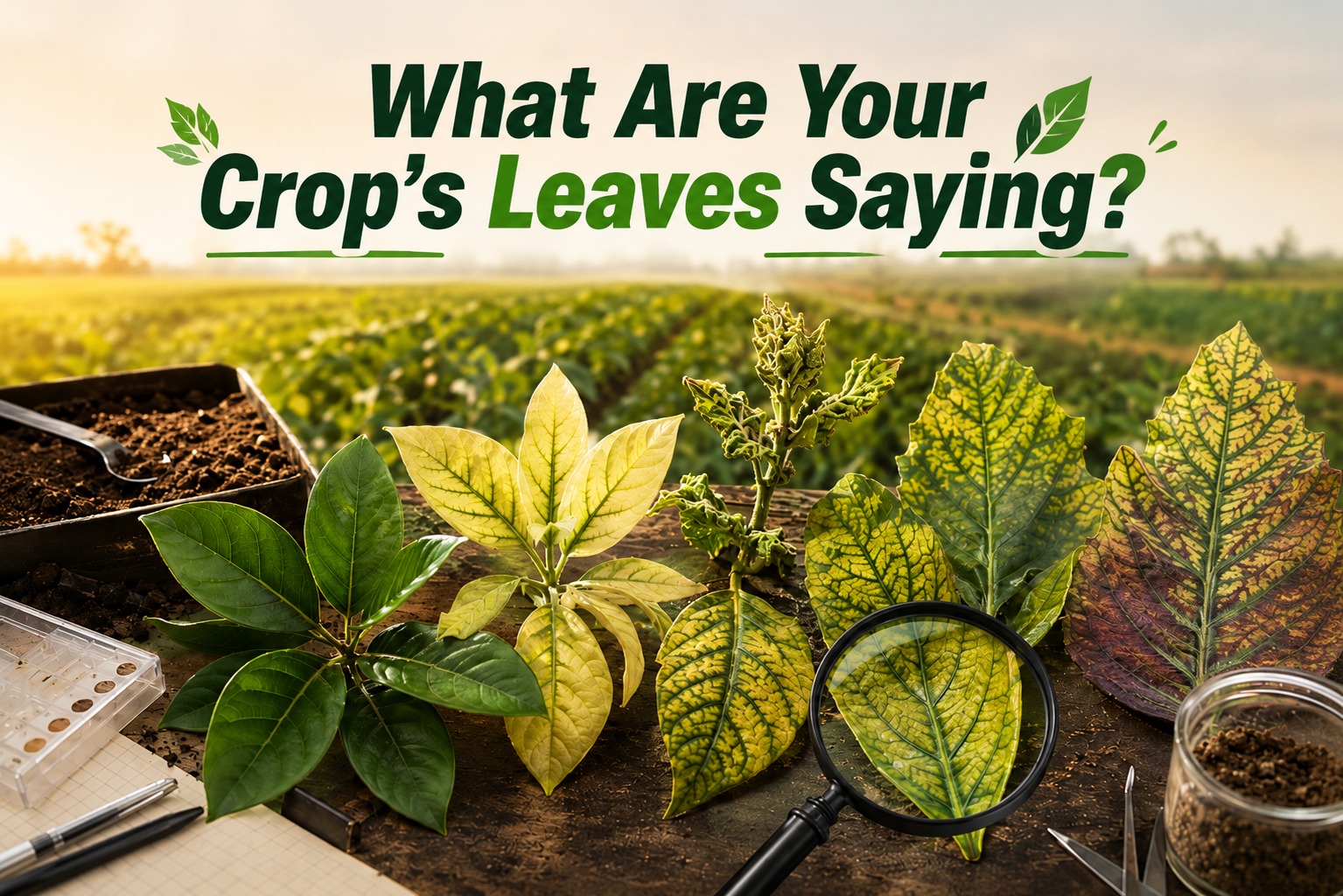
Micronutrient Deficiency Decoded: What Your Crop's Leaves Are Trying to Tell You
A farmer sprays fungicide on a field of yellowing leaves. Nothing changes. He sprays again with a stronger dose. Still nothing. Three weeks and two wasted sprays later, a soil test finally shows what was happening all along: the crop was never sick. It was starving for zinc.
This mix-up happens constantly, and it's an expensive one. Nutrient deficiencies mimic disease symptoms closely enough that even experienced growers reach for the wrong bottle. The good news is that plants are fairly consistent about how they show hunger, and once you know what to look for, most deficiencies can be read directly off the leaf.
The one rule that tells you where to look
Before getting into individual nutrients, there's a single question that narrows things down faster than anything else: *are the old leaves affected, or the new ones?*
Some nutrients move freely inside the plant. When supply runs short, the plant pulls them out of older leaves and ships them to the growing tip, where they're needed most. That's why deficiencies in mobile nutrients like magnesium show up on the bottom, older leaves first, while the new growth stays green.
Other nutrients can't be moved once they're deposited in a leaf. Iron, boron, and (to a large extent) zinc fall into this group. When these run short, the plant can't cannibalize its old leaves to feed new ones, so the damage shows up on the youngest leaves and growing tips first.
Old leaves yellowing, new growth fine: think magnesium. New growth pale or distorted, old leaves normal: think iron, zinc, or boron. It won't give you a diagnosis on its own, but it cuts your guesswork roughly in half before you've looked at anything else.
Zinc: small, pale, close together:
Zinc deficiency rarely announces itself as simple yellowing. Look instead for leaves that come out smaller than usual, with shortened distance between nodes so the plant looks stunted and bunched up, sometimes called "little leaf." Interveinal chlorosis shows up too, pale tissue between veins that stay green, but it's the stunted growth pattern that's the giveaway. In rice, zinc deficiency has its own name, khaira disease, where seedlings turn bronze and stop tillering. In citrus and grapes, watch for rosetting, tufts of small leaves clustered at branch tips. Maize shows broad pale bands running along either side of the midrib. Zinc lockup is most common in calcareous or high-pH soils and in fields where phosphorus has been applied heavily for years, since excess phosphorus interferes with zinc uptake. Sandy soils low in organic matter are also prone to it.
"Commonly mistaken for: viral mosaic disease, especially in maize, since both produce pale striping on young leaves."
Iron: green veins on a pale leaf
Classic iron chlorosis is one of the easier deficiencies to recognize once you've seen it: the newest leaves turn pale yellow to almost white, but the veins stay sharply green, creating a fine net pattern across the leaf. Because iron is immobile, older leaves usually look completely normal while the top of the plant looks bleached.
Citrus, groundnut, soybean, and grapevine are frequent sufferers, particularly in high-pH, calcareous soils where iron is chemically present but locked into forms the roots can't absorb. Waterlogging makes it worse, and irrigation water high in bicarbonates is a common hidden cause in Maharashtra's groundwater belts.
"Commonly mistaken for: manganese deficiency, which produces a similar but usually less extreme interveinal pattern, and sun scorch on very young leaves."
Boron: the growing tip gives up first
Boron deficiency has a distinctive habit of attacking the plant's growth points before it touches the leaves. The terminal bud can stop growing entirely, sometimes dying back, which forces the plant to push out weak side shoots and gives it a bushy, distorted shape. Stems and petioles turn brittle and may crack. Fruit and flower set drops off sharply because boron is essential for pollen viability.
Cauliflower shows it as hollow, brown-streaked stem tissue, sometimes called hollow heart. Cotton and sunflower show stunted, deformed bolls or heads. In apple and other fruit trees, look for corky, water-soaked patches inside the fruit flesh.
Sandy soils with low organic matter, and fields that have been limed heavily to correct acidity, are the usual candidates. Boron is one of the few micronutrients that's genuinely difficult to reserve in soil, since it leaches out with rainfall more readily than most others.
"Commonly mistaken for: water stress, since wilting growing tips and poor fruit set look similar to drought damage from a distance."
Magnesium: old leaves marble, then redden
Magnesium is mobile, so this one plays by different rules than the three above. Look at the oldest, lowest leaves first. Interveinal chlorosis appears there while the veins themselves stay green, giving a marbled or mottled look. In several crops, cotton and grapevine especially, the yellowed tissue eventually turns a dull red or purple before the leaf dies off completely.
Cotton, grapes, citrus, and tomato are the crops where this shows up most in Indian conditions. It's especially common on sandy, acidic soils, and on fields where potassium fertilizer has been applied heavily, since potassium and magnesium compete for the same uptake pathway in the root. Heavy potassium use without a matching magnesium input is one of the more overlooked causes of a deficiency that otherwise looks like simple old-age leaf drop.
"Commonly mistaken for: natural leaf senescence, since older leaves yellowing and dropping can look unremarkable unless you notice the marbled pattern before the leaf goes fully yellow."
When the leaf isn't enough
Visual symptoms get you most of the way, but two different deficiencies can look close enough on the leaf that a photo won't settle it, and some crops mask symptoms until the damage is already done to yield. A soil test tells you what's actually available in the root zone; a plant tissue test tells you what the crop has actually managed to absorb, which isn't always the same thing. Running both together, especially when a symptom is ambiguous or a full field is affected, is the difference between guessing and knowing.
"Fixing it once you know what it is"
Soil application works when the deficiency is genuinely a supply problem, low nutrient reserves in the soil itself. But in high-pH or calcareous soils, iron and zinc often chelate out or bind to soil particles before the roots ever reach them, so a soil-applied dose can underperform even at high rates. In those conditions, a chelated form (iron-EDDHA is the standard for iron on alkaline soils) or a foliar spray gets the nutrient into the plant directly, bypassing the soil chemistry problem altogether.
Foliar sprays are also the faster fix when a crop is already showing symptoms mid-season and there isn't time to wait for a soil-applied correction to take effect, though they tend to be a short-term patch rather than a lasting fix for soils that are chronically short on a nutrient.
The pattern worth remembering: know which leaves are affected, match it against what's above, and confirm with a test before you spend money treating the wrong problem. A lot of yield loss attributed to disease or "bad weather" traces back to a micronutrient gap that was visible on the leaf the whole time.